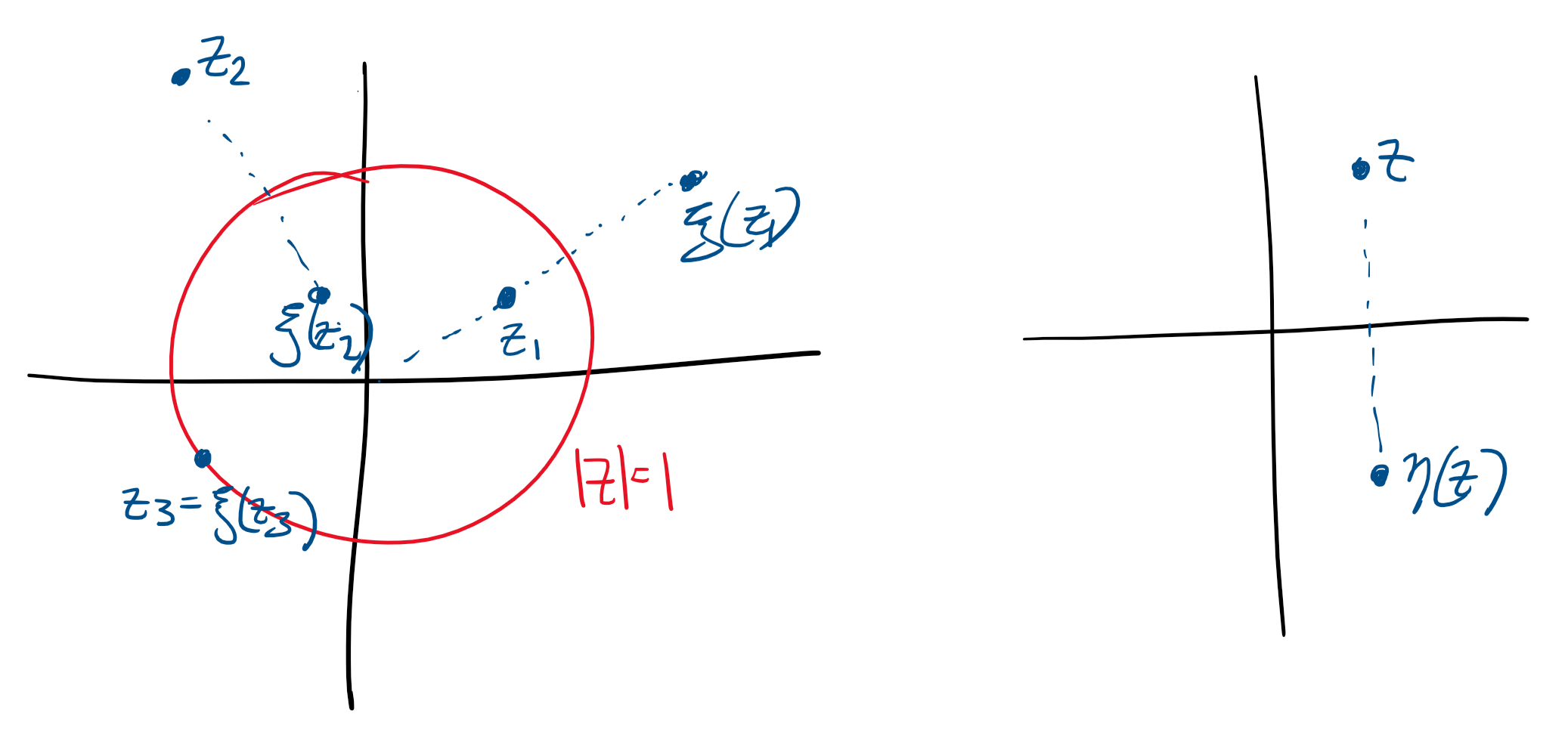
Another very important map to look at is z \mapsto 1/z on \mathbb C_*. We can write this as the composition of two slightly more complicated functions.
Define \xi(z) = z/|z|^2 on \mathbb C_* and \eta(z) = \bar z. For z \in \mathbb C_*, we can compose these two as \begin{aligned} \eta \circ \xi(z) = \eta(\xi(z)) = \overline {\left(\frac z {|z|^2}\right)} = \frac{\bar z}{|z|^2} = \frac {\bar z}{z \bar z} = \frac 1 z. \end{aligned}
\xi is called inversion, with respect to the unit circle. \eta is just reflection about the real axis.
For w = 1/z = \bar z / |z|^2 we can write it as x+iy \mapsto u+iv, where w=\frac{x-iy}{x^2 + y^2} \quad\implies\quad u = \frac{x}{x^2+y^2}, \quad v=\frac{-y}{x^2+y^2}. We can use this to show the following statement: 1/z maps circles and lines in the z=plane to circles and lines in the w-plane. Note that this does not require circles to map to circles, or lines to map to lines.
The key point is both circles and lines in the z-plane can be represented as A(x^2+y^2)+Bx+Cy+D=0,\quad\text{ where } B^2+C^2 > 4AD for A,B,C,D \in \mathbb R. If A=0, then the equation is a circle. The inequality constraint tells us that \begin{aligned} \left(x+\frac B {2A}\right)^2 + \left(y+\frac C {2A}\right)^2 = \left(\frac{\sqrt{B^2+C^2-4AD}}{2A}\right)^2. \end{aligned} Note, for w = 1/z, the u and v expressions earlier tell us that w has the form D(u^2+v^2)+Bu-Cv+A=0 which is a circle or line.
Examples: Affine transformations are bijections \mathbb C \to\mathbb C , and 1/z is a binection \mathbb C_* \to \mathbb C_*.
B.C. 99 (8th ed 93)
Let a, b, c, d \in \mathbb C where ad-bc \ne 0. Then, w = T(z) = \frac{az+b}{cz+d} is called a Möbius (or linear fractional) transformation. The natural domain of definition is - if c = 0, then \operatorname{dom}w = \mathbb C (because c = 0\implies d \ne 0), or - if c \ne 0, then \operatorname{dom}w = \mathbb C \setminus \{-d/c\}.
Let’s try to understand T geometrically.
Claim: T is injective and surjective from \mathbb C \to \mathbb C. Proof. For c = 0, then to prove injectiveness suppose T(z) = T(\xi). We want to show z = \xi. Substituting into the formula for T, \frac a d z + \frac b d = \frac a d \xi + \frac b d \implies z = \xi. To prove it is surjective, given w \in \mathbb C, we need z \in \mathbb C such that T(z) = w. The value z = d/a(w-b/d) satisfies this.
For c \ne 0, consider \begin{aligned} w &= \frac{az+b}{cz+d} = \frac{a(z+d/c) - ad/c + b}{c(z+d/c)}\\ &= \frac a c + \left(\frac{bc-ad}c\right)\frac 1 {cz-d} \end{aligned} This is a composition of a linear transformation, 1/z and another linear transformation.
Thus, T is the composition of linear and 1/z maps. That is, Z_1 = cz+d, \quad W = 1/Z_1, \quad w = \frac a z + \frac{bc-ad}cW. In both cases, Möbius transformations are compositions of maps previously studied. This means they are bijective.